
Global Standards in Ecological Restoration
A Conversation with Kiran Baldwin of Auroville’s Botanical Gardens
Introduction
Auroville Botanical Gardens, located in the heart of India’s experimental township Auroville, is making waves on the global conservation stage. From pioneering ecological restoration practices to participating in the development of the internationally recognized Global Biodiversity Standard, the Gardens serve as a hub for both research and practical action. In this interview, Kiran Baldwin, coordinator of The Global Biodiversity Standard (TGBS) hub in India, shares his journey—from growing up amidst Auroville’s reforestation efforts to shaping a global framework for biodiversity
Attending the SER 2025 Conference in Denver
AVI USA: Hi Kiran, it’s so nice to meet you in person on this beautiful day in Auroville. We’re in early monsoon season, but it’s wonderful we can meet outdoors under a blue sky. I know you were recently in the US, in Denver, for the SER 2025 Conference—not only as a participant but also as an invited presenter. Can you tell me a little about the conference and how you became involved as a presenter? And congratulations on this amazing step in your work as a conservationist.
Kiran: Thank you. The conference I attended was the 11th World Conference on Ecological Restoration, organized by the Society for Ecological Restoration (SER), a US-based organization that operates globally in the field of ecological restoration. They have written the international standards for ecological restoration and are one of the key partners for the UN Decade on Ecosystem Restoration.
I was invited to the conference because of a project called The Global Biodiversity Standard. This project provides a framework to measure changes in biodiversity at the site level—essentially assessing how restoration projects impact biodiversity. The project was initiated by Botanic Gardens Conservation International (BGCI) and SER, along with several other global organizations, andlocal hub organizations.
We at the Auroville Botanical Gardens were part of the initial cohort of hubs. This project, funded through the Darwin Initiative for five years, started with developing the standard using existing knowledge from global organizations , as well as small organizations like ours that run projects on the ground. The mission was to create a standard that could work across the globe while being applicable to real-life restoration projects.
Click below to read the intro and methodology of The Global Biodiversity Standard.
Introduction Booklet
Introduction to Methodology
Understanding Ecological Restoration
AVI USA: Could you explain a little more about ecological restoration? I understand the basics of ecology and conservation, but how does ecological restoration work?
Kiran: Ecological restoration is fundamentally about recovery. It focuses on restoring a degraded ecosystem toward a reference model, which represents what the ecosystem would have been like if it had not been altered by degradation. This can include human-caused damage or rapid climate change, such as species dying off due to drought, extreme rainfall, or rising temperatures. Restoration ecology is about recovering the entire ecosystem—not just trees or animals, but also soil, water, and the interactions between all living and non-living components.
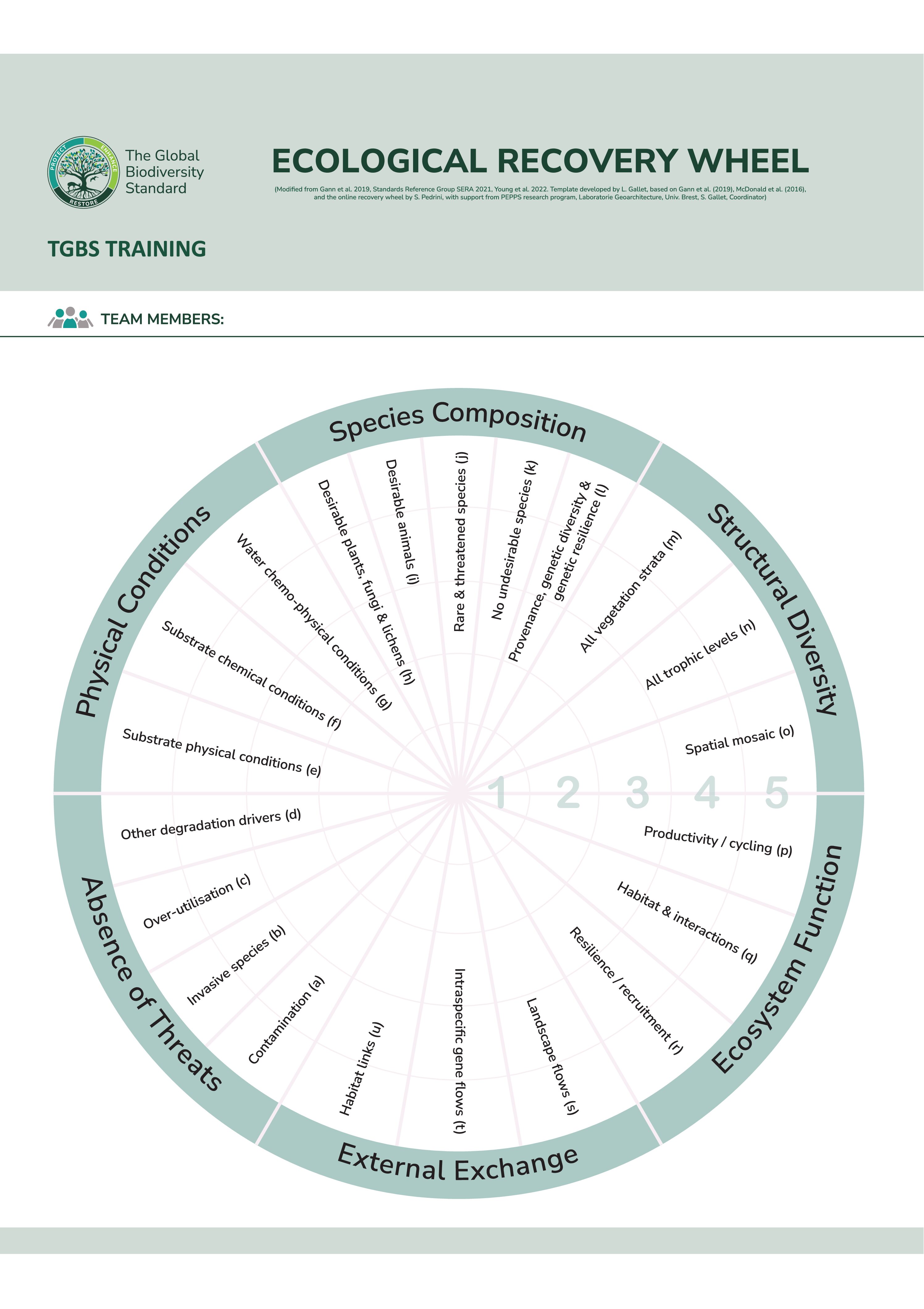
Restoring an ecosystem is complex, but standards and tools make it manageable. One such tool is the Ecological Recovery Wheel, developed by SER, which splits an ecosystem down into 6 Key components:
Absence of Threats: The sources and drivers of degradation as well as the mitigation measures in place.
Physical Conditions: Substrate type e.g., rock, sand, clay, and chemical properties such as calcium, magnesium, iron, and silica. As well as hydrology and water conditions.
Species Composition: All plants, animals, and fungi in the ecosystem, including identifying invasive or non-native species that might disrupt the natural balance.
Structural Diversity: The physical structure of the ecosystem—for example, a forest has a canopy, understory, and ground layer; a desert primarily has grasses. The trophic structure—the web of predators, consumers, and other interactions—is also considered.
Ecosystem Function: Processes such as nutrient cycling, soil accumulation, water filtration, and plant growth or reproduction.
External Exchange: Interaction with surrounding landscapes, including seed dispersal and habitat connectivity.
This framework allows us to assess the current state of an ecosystem and plan restoration interventions, whether planting native species, clearing invasive species, or creating new habitats to enhance biodiversity. The Global Biodiversity Standard incorporates these principles to create a functioning assessment and certification tool for restoration projects.
Auroville Botanical Gardens in the Global Network
AVI USA: So the Auroville Botanical Gardens is involved as part of the TGBS network?
Kiran: Yes, exactly. We were the first hub in Asia to be part of this project, working alongside hubs in Africa and South America, the network has now grown to 14 countries. Over the past few years, we have been testing the methodology, publishing results, and eventually launching it as a certification standard. Now, sites undergoing restoration work can apply to be certified against The Global Biodiversity Standard, which provides an internationally recognized framework to evaluate and improve biodiversity outcomes.
AVI USA: That’s amazing. I wasn’t aware of all the detailed work happening in this space, and it’s wonderful to see Auroville playing a role on a global scale.
Growing Up in Auroville
AVI USA: You were born in Auroville?
Kiran: Yes, I was born in Auroville, in the Greenbelt. Both my parents, Glen and Sophie, were involved in tree planting and reforestation. I grew up in that space—during the monsoon we’d go out and plant trees—so there’s always been a connection to that work.
But I didn’t plan to make it my career. I loved building things, especially metalwork, and I learned welding when I was young. I wanted to study mechanical engineering in a hands-on program, but I’m not someone who particularly enjoys sitting in classrooms.
I had found a practical course and was ready to begin when COVID hit. I was in Sri Lanka for a short visit, got stuck there during the lockdowns, and couldn’t return home. Like many people at that time, I ended up rethinking my direction. Even though I loved mechanical work, I realized I didn’t want to do just one thing.
Discovering Ecological Horticulture
When I finally returned to Auroville, I visited Paul at the Botanical Gardens to see what was happening and asked if I could help on a project. Around that time, the gardens were offering an Ecological Horticulture Course, so I joined in a hybrid way—learning while also working on real projects.
I immersed myself in identifying tropical dry evergreen forest species, understanding ecological restoration, and learning how to read a landscape—how to walk a site, assess its condition, and plan the most effective way to restore it.
Restoration isn’t always about planting trees. Sometimes it’s enough to fence an area to limit grazing, though that also restricts wild animals, so every intervention has trade-offs. The goal is to initiate recovery—to kick-start a process where the ecosystem can sustain itself. That’s how I started. It happened very organically.
Developing the Global Biodiversity Standard
Kiran: The Global Biodiversity Standard project began in 2021.. I worked with Paul on it for the India hub.
Our role as one of the hubs across the world was to ensure the standard would be relevant to smaller organizations like ours, not only large international institutions. The goal was to co-develop something that worked for everyone—from global conservation bodies to local field projects. The ambition was to have a rigorous and globally standardized framework but with a local and specialized approach.
Our role was to ensure the standard would be relevant to smaller organizations like ours, not just large international institutions. The goal was to co-develop something that worked for everyone—from global conservation bodies to local field projects.
I was especially drawn to the mapping component. I learned GIS and other mapping tools, collecting GPS data in the field and translating it into maps with boundaries, zones, and features. Over time, I took on more responsibilities, including conducting vegetation, fauna, and soil surveys to understand sites before any restoration began.
During the development and testing phases, we visited projects around India—some long established, others newly started—to see how the methodology worked in practice. The key was that each assessment needed to reflect the real situation on the ground. We gathered information from different ecosystems and contributed it to the international team, helping to shape a framework that’s global yet adaptable to local conditions.
Assessments are always carried out by local experts who understand their ecosystems—because indicator species, soil characteristics, and ecological signs differ from place to place. For instance, the presence of certain migratory birds or rare plants can signal that an ecosystem is recovering.
Over time, I took on a larger role, and now I coordinate the Global Biodiversity Standard hub in India. We’re expanding the team and supporting projects nationwide.
AVI USA: I didn’t realize you were running the hub. That’s amazing.
Kiran: Thank you! It’s exciting and a huge learning experience.
Looking Ahead: Scaling Impact and Collaboration
AVI USA: You’ve got about a year and a half of funding left. You’ve already created the standard, applied it, and started training new hubs. What comes next?
Kiran: The focus now is on making the Global Biodiversity Standard self-sufficient so it can continue beyond the initial funding. Each site assessment has a cost, which might be covered by the project itself, its funder, or a sponsor. But the bigger goal is to create enough demand that the standard becomes the recognized global framework for measuring biodiversity change.
There’s some competition emerging, but we have an advantage in time and experience. In India, we work closely with the Ecological Restoration Alliance of India (ERA-India). It’s a parallel effort that started around the same time, about four years ago.
The ERA-India was created as an alliance rather than a formal organization, bringing together individuals, NGOs, and institutions under one informal network. It began with volunteers sharing their time and expertise, and now it has created about fifteen full-time jobs. The alliance is organized into “desks,” each hosted by a member organization. At Auroville Botanical Gardens, we host the Knowledge and Resource Desk, which focuses on developing seed germination protocols, species databases, and ecoregion reports.
India has fifty-one ecoregions, yet there’s no single resource showing what native species, plants, and animals belong to each. That’s one aim of what the ERA-India is building—a comprehensive database of information. It’s a massive task, but essential for guiding restoration work.
The ERA-India’s efforts directly support The Global Biodiversity Standard. The more the restoration community shares knowledge and best practices, the more projects can reach high standards and qualify for certification. Often, people have great intentions but lack information—they might plant non-native trees simply because that’s what nurseries offer. What’s missing isn’t necessarily effort or even funding, but rather access to the right resources.
AVI USA: So the next step is spreading the standard through ERA.
Kiran: Exactly. And for me, it’s important that this work is rooted in India. I was born here; Auroville is such a multicultural hub, and focusing this work here feels like giving back to the land that made it possible.
AVI USA: That’s wonderful. Thank you, Kiran. It’s been great hearing about your background, your development, this incredible project, and your vision for the future.
Kiran: Thank you.
AVI USA: We wish you all the best. AVI USA will stay in touch and continue sharing updates on your work.
Kiran: Absolutely. If anyone would like to connect, they can find me on LinkedIn—Kiran Baldwin—or visit biodiversitystandard.org. You can also look up the Auroville Botanical Gardens online.
AVI USA: Perfect. Thank you so much, Kiran.
Kiran: Thank you.