
Roy Chvat: In Memoriam
by Akash Kapur
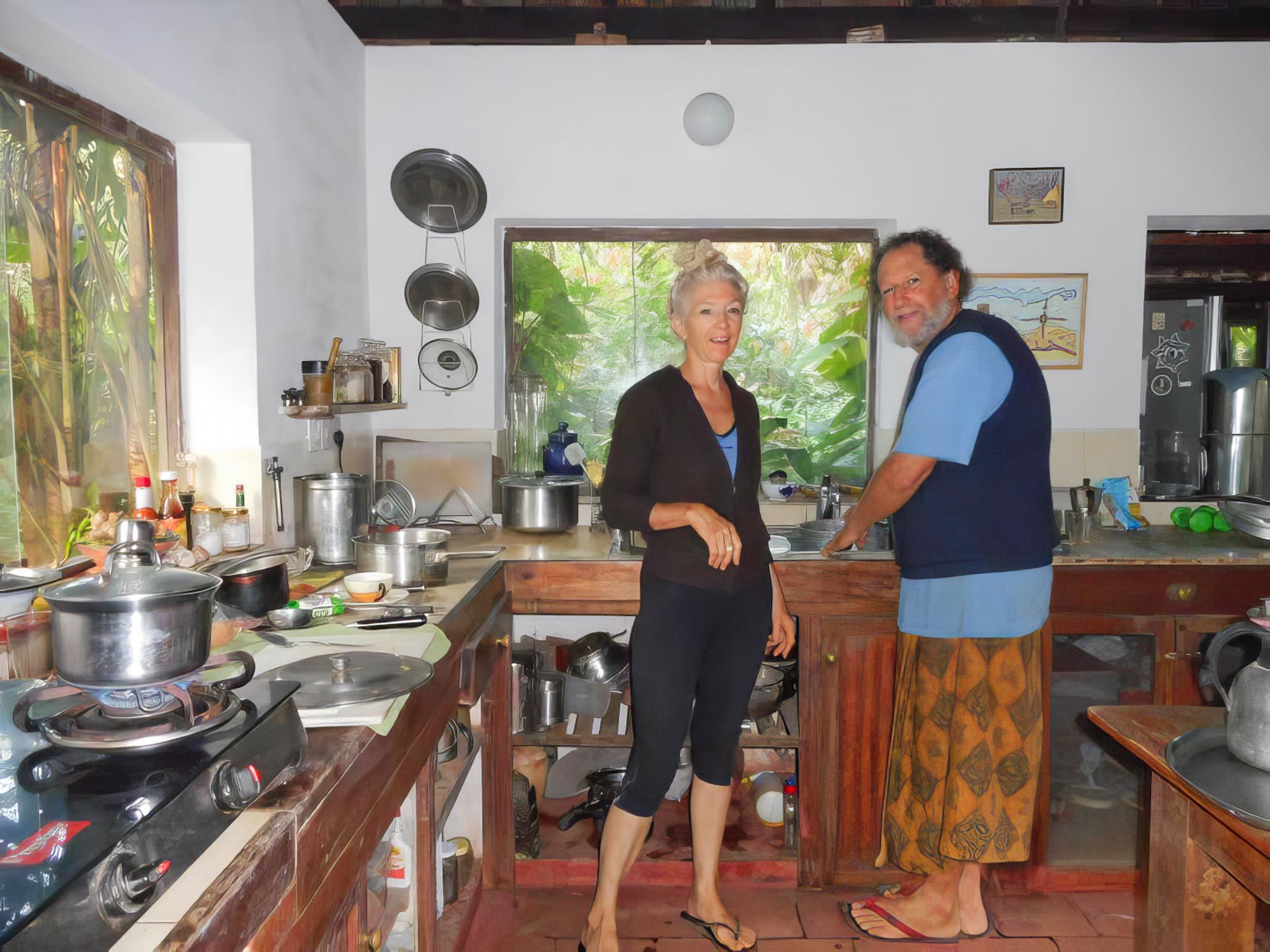
Much of what I know about Roy’s early years in Auroville—and about the early years of Auroville itself—I learned directly from him. Roy and I were neighbors in Aurodam when I was writing my book, Better to Have Gone, and I would often walk over to his house, hoping to elicit stories and memories.
He was a great raconteur and he had a formidable memory, though it could be frustratingly quirky. Early on, I would amble over to Roy’s place with a pen and notebook, hoping to “interview” him. But Roy was a deeply informal guy, and it was as if his brain collapsed in the face of all that structure. I soon learned that the trick was to hang around, make small talk, drink coffee, banter about the news (Roy was an avid reader of the New York Times and the New Yorker)–and then, suddenly, without prompting, his brain would switch tracks and the stories would pour forth, rich with detail, insight, and all of Roy’s characteristic humor.
So that’s how I learned a little about Roy’s life, both in Auroville and before. He told me about his father’s business, which apparently fell on hard times; he showed me a picture on Google Maps of the home where he and his sister, Carol, had grown up, in Maplewood, NJ. He was an Art student at Boston University; when he hit a high draft number during the Vietnam War, thus enabling him to avoid conscription, he dropped out of college and moved to an urban commune in San Francisco, where he discovered Sri Aurobindo.
He told me stories about digging foundation pits for the Matrimandir, sweating alongside Larry, Johnny Walker, and others as they chipped into the hard red earth with crowbars. Then, after they had dug for weeks, a group of townplanners came by in their Jeeps from Pondicherry and told the diggers that the location for the Matrimandir had been moved, and ordered them to fill the holes and start again in another place. “So much for their sacred town plan,” he said, ruefully. Roy always had a strong sense of the ridiculous—a kind of ironic detachment and perspective that he carried with him even in recent years, as roads came up around his home and life in Auroville changed so dramatically.
Many of Roy’s stories revolved around the bakery he was part of creating in Kottakarai with Larry, Sundaram, and others. Like so many projects in those early days—like so many projects throughout Auroville’s history—the bakery was a complex mix of high-minded idealism and amateurish improvisation, in equal parts inspirational and absurd. Roy loved talking about how he and his friends were determined to try to uphold the vision of a cashless economy in Auroville—and of how difficult that was in practice.
One way the bakers attempted to realize that vision was by asking people to purchase their own grains in Pondicherry, thus maintaining at least the illusion that no money was changing hands. It was not lost on Roy that this was a somewhat convoluted way to uphold the dream. Eventually, the unnatural arrangement collapsed on itself and the bakery’s clients grew increasingly frustrated. One day, Roy recalled, an Aurovilian threw his bread on the ground and began abusing him. He insisted it was the bakers’ job to cycle to Pondy and purchase wheat, and he thrust cash into Roy’s hands, cursing and turning red in the process.
Roy, as ever, was unflappable. In his telling, he simply stood there. Eventually the man burned out, and Roy returned to baking. “We soon learned that this no money thing was going to be a little harder than we’d imagined,” Roy told me decades later, always the master of understatement.
***
Roy was chilled out. That’s my abiding memory of him, and the lingering sensation I have whenever I think of him. Even in the early years of his cancer, when he suffered the terrible stress of trying to get treatment at JIPMER amidst a harsh Covid lockdown—being blocked by police check posts, never knowing when he set out in the mornings if he’d actually be able to access the prescribed radiation—I rarely saw him ruffled or agitated. One time I asked him if he was feeling anxious, and he replied with a line from a character facing execution in The Bridge of Spies, a Cold War spy movie he admired: “Would it make a difference?”
Roy’s unflappability was a core part of his being; it was emotional, psychological, and physical too. He carried himself in a low-key, self-effacing way, slightly hunched over. His speech was low and monotonous, and he had a way of smiling that was gently sardonic (but never sarcastic), as if he recognized that nothing really mattered that much. He had a strong sense of the concept of Maya; I think he lived—and died—with a determination not to let the illusions or ephemerality of existence burden him.
Roy’s calmness was also a big part of his skill as a cook. Sometimes on weekend evenings we would barbecue together at my place, on a metal grill I’d bought at Currimbhoys, down in Kottakkuppam. Grilling can be a stressful experience, especially on hot summer days when the current goes out and the flames are too high and the chicken starts blackening on the outside even while the inside remains pink. None of that fazed Roy. He just kept at it, tossing and turning whatever was on the grill, moving things around skillfully with his mud-streaked, callused hands, seemingly impervious to the flames, all the while telling stories and sipping wine. Roy loved good wine. Some of his happiest memories were of his travels in France, when a friend with a chateau opened up his cellars; or of the time he stayed with a woman in downtown New York City, and she let him use her credit card to buy $80 bottles of wine.
Anyone who knows Roy knows that he was a formidable chef. Living next to him meant being on the receiving end of a steady stream of culinary experiments and inventions. For a while, it was bagels (this was long before the days of Bread and Chocolate and all the sophisticated baking that’s now taken over the region); then it was homemade tofu, delicious and creamy in a way that I never knew tofu could be. And, of course, there was his signature dish: the legendary red rice dosas and idlis. At some point in our friendship, I embarked on a rigorous low-carb diet. I was strict and disciplined with myself—except on Sundays, when I would visit Roy for his famous lunches, at which point all my rigor collapsed under a mound of delicious, fluffy, and irresistible carbs.
The food was undeniably wonderful. But what really made those Sunday afternoons special was the spirit with which Roy and Gillian hosted: the generosity, the casualness, the open-door warmth. No planning or invitation was required; a wide range of people just showed up and dug into the food. In my mind, Roy will always be standing at his stove, clad in worn-out rubber sandals, lungi hanging low, ladle in hand as he unhurriedly tastes and adjusts. Roy at his dosa stove embodied a kind of effortless generosity, a warm-heartedness that made everyone feel at ease.
***
These qualities inspired deep loyalty and love—gifts that Roy was blessed to receive his whole life (notably from his partner of 42 years, Gillian), but that were perhaps most evident in his final years. In Auroville, a team of caretakers and supporters—Larry, Ribhu, Lila, and others —emerged, guiding Roy through his illness. A fundraising drive set up by Auralice for his treatment succeeded beyond expectations, with money coming in from around the world–including one sizable donation from an old high school friend who hadn’t had contact with Roy in decades but remembered him for his humor and sense of adventure.
People loved Roy, and he loved them in return. He wasn’t the most emotive man, but he was deeply caring and empathetic, and he had a true capacity for connection and friendship. (Auralice and I were great beneficiaries of those talents). That is why, I think, he was so disheartened by some of the events of recent years in the community. He was saddened and a little incredulous about all the division and rancor—some of which, to his (and my) surprise, was directed at him.
One of the few times I’ve seen Roy ruffled was on an evening when he came over to my place, sat on my back porch, and told me he felt isolated, like he’d been abandoned by several friends. This isn’t the place to get into details, except to say that Roy was at this point being pressured to prove his loyalties by quitting his job at the AV News and Notes, and he was being subjected to a certain amount of ostracism because he resisted the pressure. He seemed hurt, and dismayed. His Auroville was not an Auroville of litmus tests and loyalty purges; Roy told me that he thought those days were behind the community.
I hesitated to include the above moment. Ultimately, I decided to keep it in because I think it says something important–about Roy himself, the kind of person he was, but also the kind of Auroville he believed in and worked for his whole life. Roy was utterly, deeply committed to Auroville; he was part of a group that has given everything to building this town, that has spent decades in service of a cause and a community. Within that group, there has always been something of a split—between the humanists and the ideologists. Roy was resolutely in the former camp. He was deeply, wonderfully, beautifully human. The Auroville he was building began with people, with human relationships and interpersonal care and love. As shocking as it could seem to him that homes and lives were being destroyed in the names of roads so, I think, it was equally shocking that his own friendships could come under strain, and that personal ties and relationships forged over decades could be subjected to ideological questioning or loyalty tests.
When he spoke to me that evening on my back porch, I heard the voice of a man distressed not for himself, but for his community. That was also around the time he told me that one good thing about his illness was that it didn’t leave him much space to dwell on the conflict and tensions all around him. “I guess I should be grateful for that,” he said, and he laughed. The comment was vintage Roy: dry humor, stubborn realism, and an insistent, defiant moral clarity.
***
Earlier this year, I walked over to Roy’s place one late morning to see how he was doing. He was hunched over his guitar—the new, pricey PRS guitar that Larry had carried from America–and he was playing Pat Metheny. He stood up when he saw me, slowly put away his instrument, and we went out to his verandah. He was skinny and frail, and his voice was creaky and ravaged from the radiation. But his mind was sharp, and he talked to me about current affairs (the war in Gaza, American politics) and he reminisced about his travels, expressing a desire to visit America and see his sister one more time.
His health had been in decline over the last few days; an oxygen tube now sat at the bottom of his bed. It was, in fact, to be one of the last times I would see him. When I asked if he was worried, he replied with that deadpan line: “Would it make a difference?”
“I’m too lazy to be anxious anyway,” he added. It was a glib, throwaway comment. Roy could be self-deprecating, and he sometimes denigrated his calmness as a form of insufficiency or lack of motivation.
But now, as he looked at me, his eyes weakened and glazed over by illness, I saw the more profound, even philosophical, side of that laid-back attitude. “The truth is I really believe it’s all Brahman, all one, and we are just one drop in a vast ocean,” he said. “I’m more convinced of that than ever.”
Yes, Roy was chilled out, and he cracked a lot of jokes, and he was certainly quirky. He was also one of the wisest, most luminous people I’ve known.
“When I’m gone, I’ll just be one drop in the ocean.”