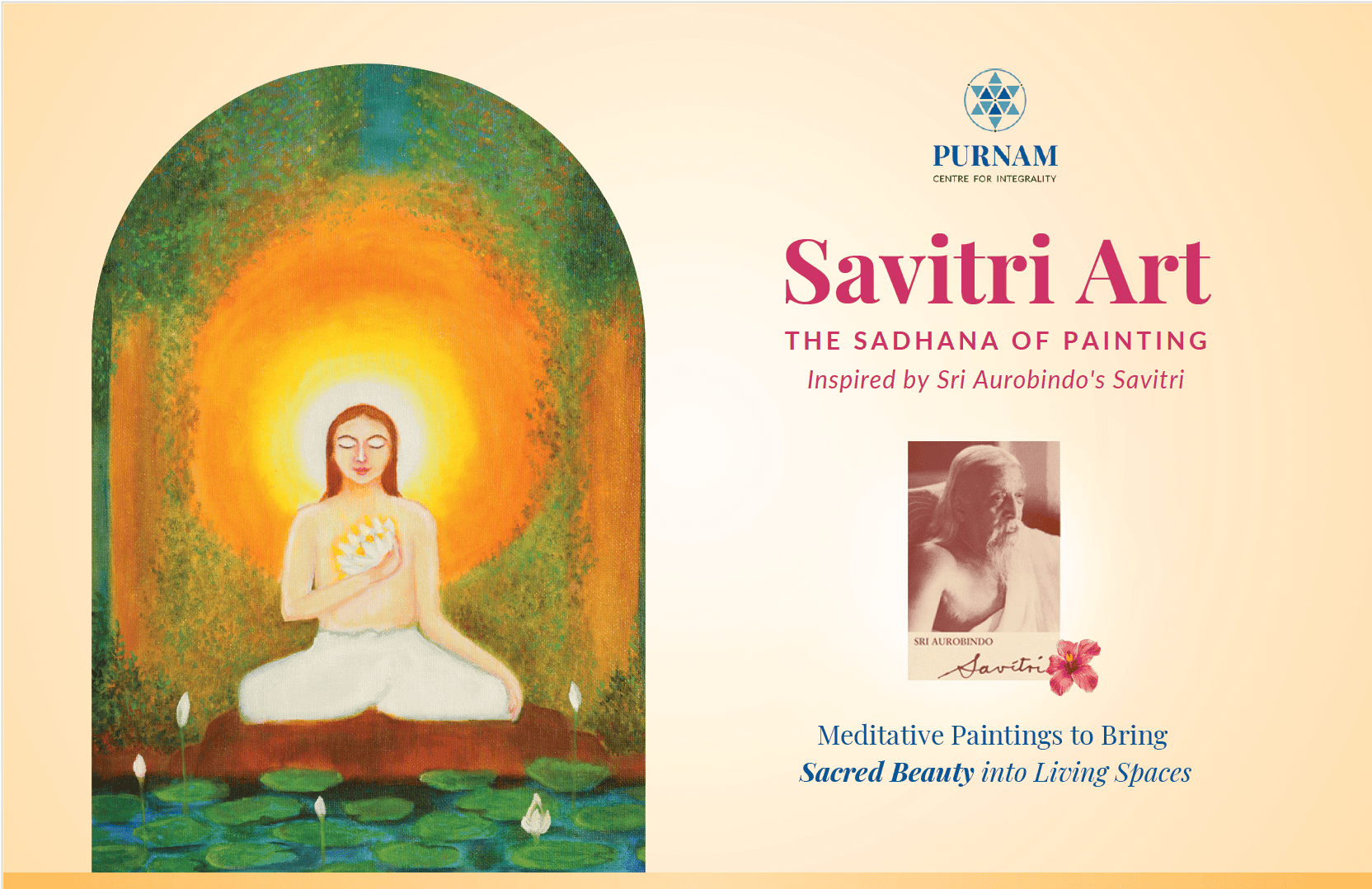
Savitri Art Sadhana
An Art Offering from Purnam Community
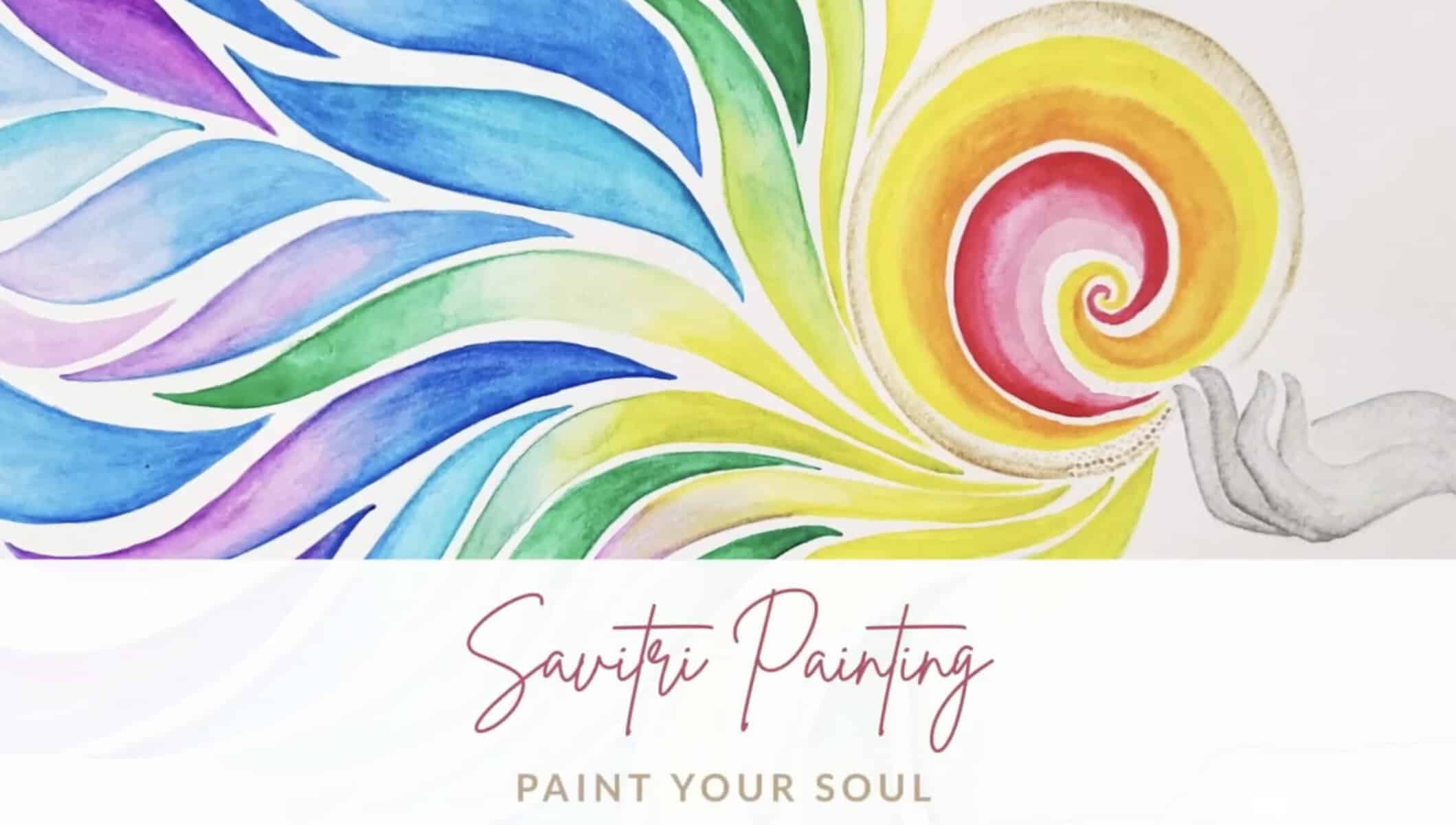
Savitri Art Sadhana
On March 29 2020, as India entered its first COVID lockdown, the mood was quiet and uncertain, everyone was affected by global lockdowns. At Purnam Community, a small international group had been gathering online to study the Mother’ teachings on the 12 qualities of the soul. During the first wave of lockdowns, a few women from this group reached out to Divyanshi, Founder Executive of Purnam, requesting for starting a Savitri reading circle, Sri Aurobindo’s epic poem, and so on April 5th the first Savitri readings started.
At first, the Savitri readings were more typical, about four pages per session, with contemplation and sharing. Everyone’s inner experience was full, the upheaval of the first weeks of the lockdown left its mark in a strong desire for the inner experience. In the weeks that followed, the readings became shorter and the inner experience gained more and more depth. Four pages slowly became two, then two pages became a single passage, and a single passage became two lines.The two lines were read over and over again until an inner understanding of the line began to arise in the group.
To make the experience more present and more real, someone suggested – “Why not color or paint a few lines of Savitri?“
This simple idea was the source of what would become through a process of artistic and spiritual discovery, the Savitri Art Offerings.
Members of the circle experimented with painting the one line of the poem every day for a week or a month, uncovering the full expression that lives in every line.
One Line, One Month
The practice that emerged was simple: take a single line or phrase from Savitri and paint it every day. Not illustrate it, sit with it, meditate on it, and paint it again and again. Participants found themselves returning to the same line for weeks, sometimes for an entire month. The repetition became a path to enter the sacred space of the poem, a material bridge of color pigments and paper to bring the inner experience alive and fully connect with the poem. It became a deep meditation to enter into one’s deeper self.That same year, a twelve-week course was built and organized for twelve women, in the month of Sri Aurobindo’s birth anniversary. Every one of them experienced a deep sense of transformation from completing the course. The course has continued in various forms ever since.
A glimpse into the Savitri Painting Circle

Who It Reaches
Course participants have come from many different backgrounds, some with no experience or knowledge of Sri Aurobindo’s works and some devotees who had kept Savitri on a shelf for decades, feeling it was beyond them; found themselves reading and engaging with it for the first time. People without formal art training participated alongside professional artists. Bringing the lines to life in meditative painting created a spark of understanding and a deep connection for all.
The Birth of Savitri Art
In April 2021, shortly after completing a Vipassana retreat, Divyanshi Chugh reached out to Savitri Painting Alumna, Usha Arvind, Padma Presingu, and Sahana Uppar to help bring into form the sacred visions she had received in silence. What began as a gentle exploration grew organically into Savitri Art Sangha—a quiet, intimate space of sadhana of art.
Please refer to this exhibition opening talk for more details on how it all started (from 3:00 to 40:00).
The 150 Paintings Project
For Sri Aurobindo’s 150th birth anniversary, the group committed to offering 150 paintings. The process was rigorous. Artists submitted drafts — in some cases up to 65 revisions before a work was accepted. Weekly thirty-minute review meetings provided feedback throughout. The entire project was done on a volunteer basis — no artist received no financial compensation.Ten of the paintings were offered permanently to Savitri Bhavan in the presence of Shraddhavan.In August 2022, the final 150 paintings were offered symbolically through an exhibition at Savitri Bhavan. Later they were photographed, color-corrected, and archived at the Auroville Archive with climate control.
Distribution and Care of the Work
The prints of some of these works are available publicly via Purnam’s platform. But originals were carefully preserved and held back for quite some time. After much reflection, with a sacred intention of spreading the vibration of Savitri across the world, these original paintings are being offered to centers, communities, and individuals who can truly value them and who have contributed meaningfully to the work of The Mother, Sri Aurobindo, and to humanity at large.
Over the past year, we have had the privilege of offering original pieces to Her Majesty The Queen Mother of Bhutan, Jetsun Pema; Padma Shri Tara Jauhar; Dr. Alok Pandey; Dr. Ananda Reddy; The Gnostic Centre; the Tibetan Pavilion and Sadhana Forest in Auroville; as well as several leaders of organisations engaged in meaningful social work.
The group thinks carefully about where paintings go. The intention is for them to reach people who will genuinely value them — not for broad distribution, but for considered placement. Revenue from print sales covers only the running costs: framing, materials, storage.
The Practice Underneath and the current work
The paintings are created as, in the language the group uses, sadhana — a practice of inner development. Before painting, participants come together invoking the Mother and concentrate and meditate on the line they are working with through writing, reciting and sharing, and then paint with the Mother’s organ music in the background. The question the group returns to regularly is not what a painting depicts but the inner space it is created from.
Current work of studying the 12 Qualities and 4 Powers of the Mother’s Symbol is exploring various modalities- paintings that are without representing a human figure — a shift toward the abstract that requires, as one member put it, bringing deep emotional sincerity into form through color and space alone. The sangha has been meeting online biweekly and collectively concentrating on each quality, one after the other.Savitri Art Offerings fundraising has primarily supported artists’ minimal material costs – pigments, oils, canvas, and basic set up for storage and gifting costs, including framing, packing and transportation of selected works and conducting Open Savitri Painting sessions at some physical spaces.
There is a lot of thought surrounding each painting placement and destination, with the strong intention that each Savitri work is placed in a setting where its inner vibration can unfold.Past issues, such as damage to paintings and reliance on lower-quality reproductions, have reinforced the importance of maintaining the original vibration and consecration of the works.
Looking Forward
Workshops have been offered at several centers — the Integral Healing Center, the Gnostic Center, and others — making the Savitri painting experience available beyond the core group. Planning is underway for offerings connected to the Mother’s 150th anniversary in 2028, with an emphasis on quality over quantity.
The project began in the quiet of the lockdown—with a few people reading two lines of the poem and wondering if they could be painted. Six years on, it has become a living, sustained practice—one that continues to return to a single question:
What is Savitri evoking within me?
Click to browse and download the Savitri Art Booklet, an offering from Purnam Community