Aikido in Auroville:
A Practice of Discipline, Presence
and Transmission
Auroville’s Aikido Dojo is one of AVI USA’s newer project partners. For nearly 50 years, practitioners here have sustained the practice through changing teachers and temporary training spaces, eventually building a permanent dojo that now serves children and adults and connects with Aikido communities worldwide.
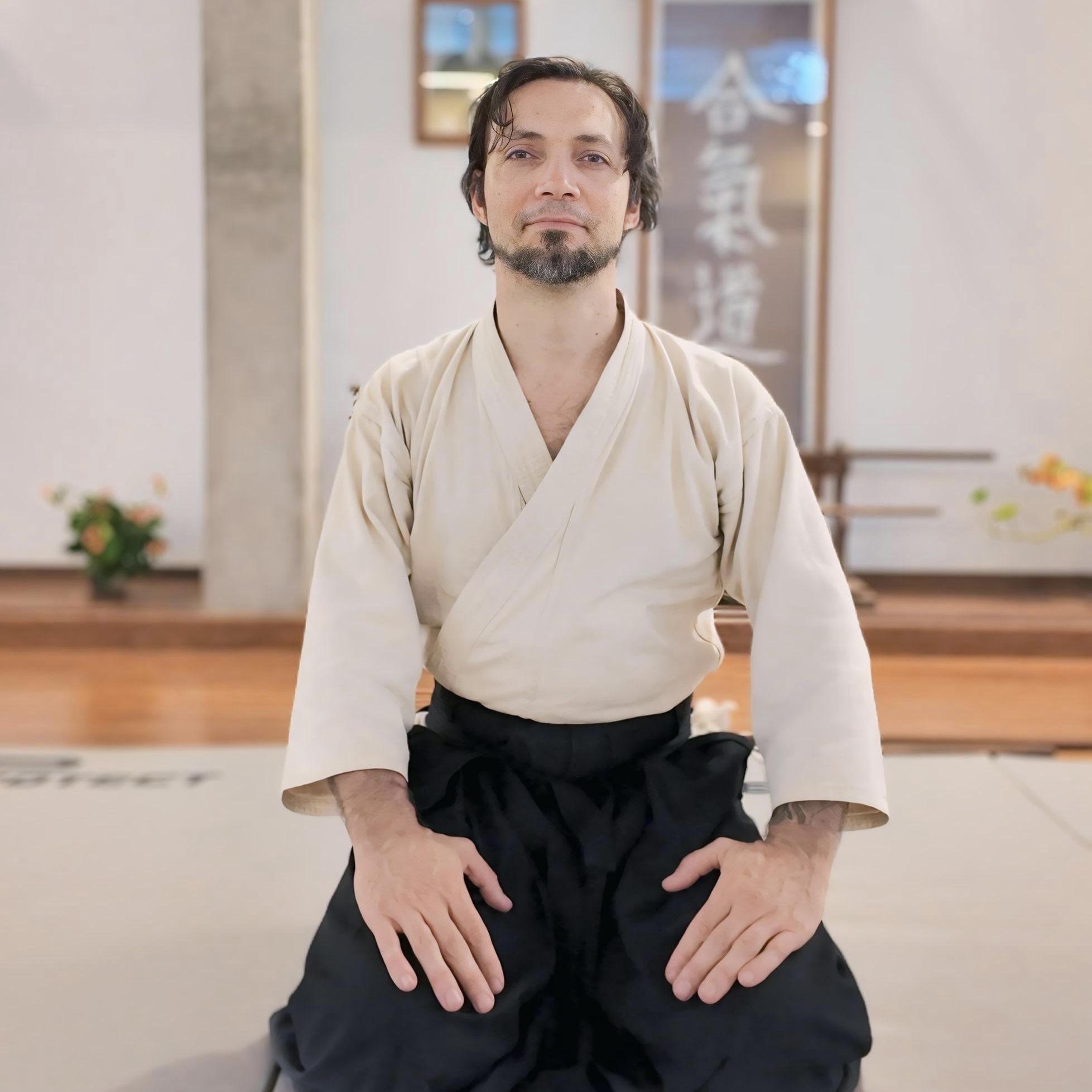
At the heart of this story is Cristo, who has practiced Aikido in Auroville for decades and continues to teach, train, and pass the practice to a younger generation. His journey reflects not only physical discipline, but a deeper connection between the body, consciousness, and the teachings of Sri Aurobindo and the Mother.
For Cristo, consistency is part of the practice itself: returning to the mats every morning, training the body and mind to respond rather than react, and gradually deepening a discipline that becomes a lifelong path.
Aikido first came to Auroville through André Pithon, whose classes Cristo joined in the early 70s. When Pithon left in 1977 there was a void in the teaching until Ananda (Jean-François R.L. Bertaux) joined Auroville in 1982. Ananda became the teacher of Serge Brelin and Cristo until 1989. Both Serge and Cristo left Auroville and upon their return in 1991, Serge took over the teaching until his passing in 2008. Since then Cristo has been conducting classes, until now.
From borrowed spaces to a dojo of its own
For years, practitioners trained wherever space allowed—moving mats between locations, practicing without them on the floor of Bharat Nivas, and even training outdoors on sand. The lack of a dedicated space never diminished Cristo’s commitment, but the dream of a dojo remained.
Today’s dojo is, in part, the fulfillment of Serge’s dream, which he did not live to see completed. Cristo carried that vision forward when after waiting for 15 years a dojo was built in 2014 at Dehashakti. More recently, another long-held dream was realized: the dojo acquired enough tatami mats for every student to train properly, with support made possible through AVI USA.
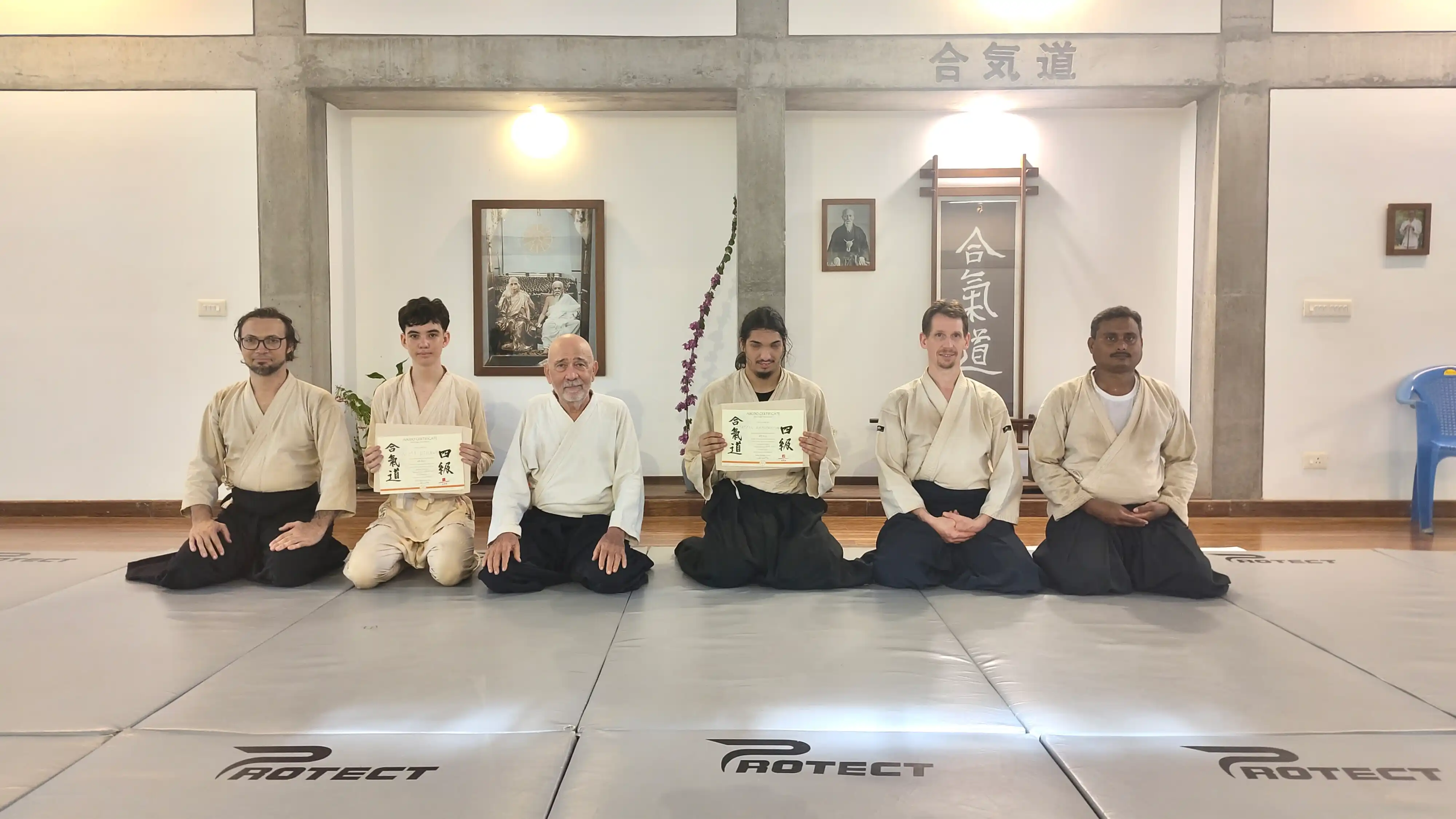
During the last 50 years thousands of people have been trained in Aikido in Auroville. The dojo serves today an average of 100 students and now offers a stable home for regular classes for children and adults from Auroville, the bioregion, and also the occasional visitor or guests. It has also become part of an international network connecting Auroville with Aikido communities in India, Europe, USA, Japan, and beyond. Visiting teachers from France, the USA and Switzerland have come for giving workshops, while Auroville students have trained abroad—a natural extension, Cristo feels, of Auroville’s role as a convergence of distinct paths to self-knowledge.
A practice for the body—and beyond
Aikido is a Japanese martial art, but Cristo emphasizes that its purpose is not competition. Unlike martial arts built around tournaments, Aikido has no competitive system; it is based on responding to attack without aggression, using movement, balance, and control rather than force against force.
“the best aikido is when you don’t have to use your skills.”
—Cristo
“There is nothing to compete,” he explains. The purpose is not to build up the ego, but to move in the opposite direction—one reason he sees a natural relationship between Aikido and Integral Yoga, beginning with the body.
The Mother emphasized physical education as part of humanity’s integral development. For Cristo, Aikido offers one way toward that development, demanding awareness of movement, balance, posture, and response. His deepest inspiration is “On Education”, the Mother’s writings on education and human development, where he finds affirmation for working consciously with the body as part of transformation. “It is about transforming the cells of the body,” he says.
“There is nothing to compete,”
—Cristo
He is careful not to claim that the Mother specifically advocated Aikido. Rather, it is the understanding behind the practice that he recognizes in her writings. He continues returning to Sri Aurobindo and the Mother, finding confirmation for the discipline of the body, the cultivation of consciousness, and the possibility of transformation.
He encourages students, especially those in Auroville, to explore these writings alongside their physical practice.
“We teach in that sense,” he says. “There is no separation.”
—Cristo
Starting young—and staying with the practice
The dojo welcomes children and adults, but continuity can be difficult, for various reasons. Cristo hopes more young practitioners will stay connected to Aikido as they grow and eventually become teachers themselves.
There have been encouraging examples. One young student whose family left Auroville was able to return, with adults helping care for him specifically so he could continue training.
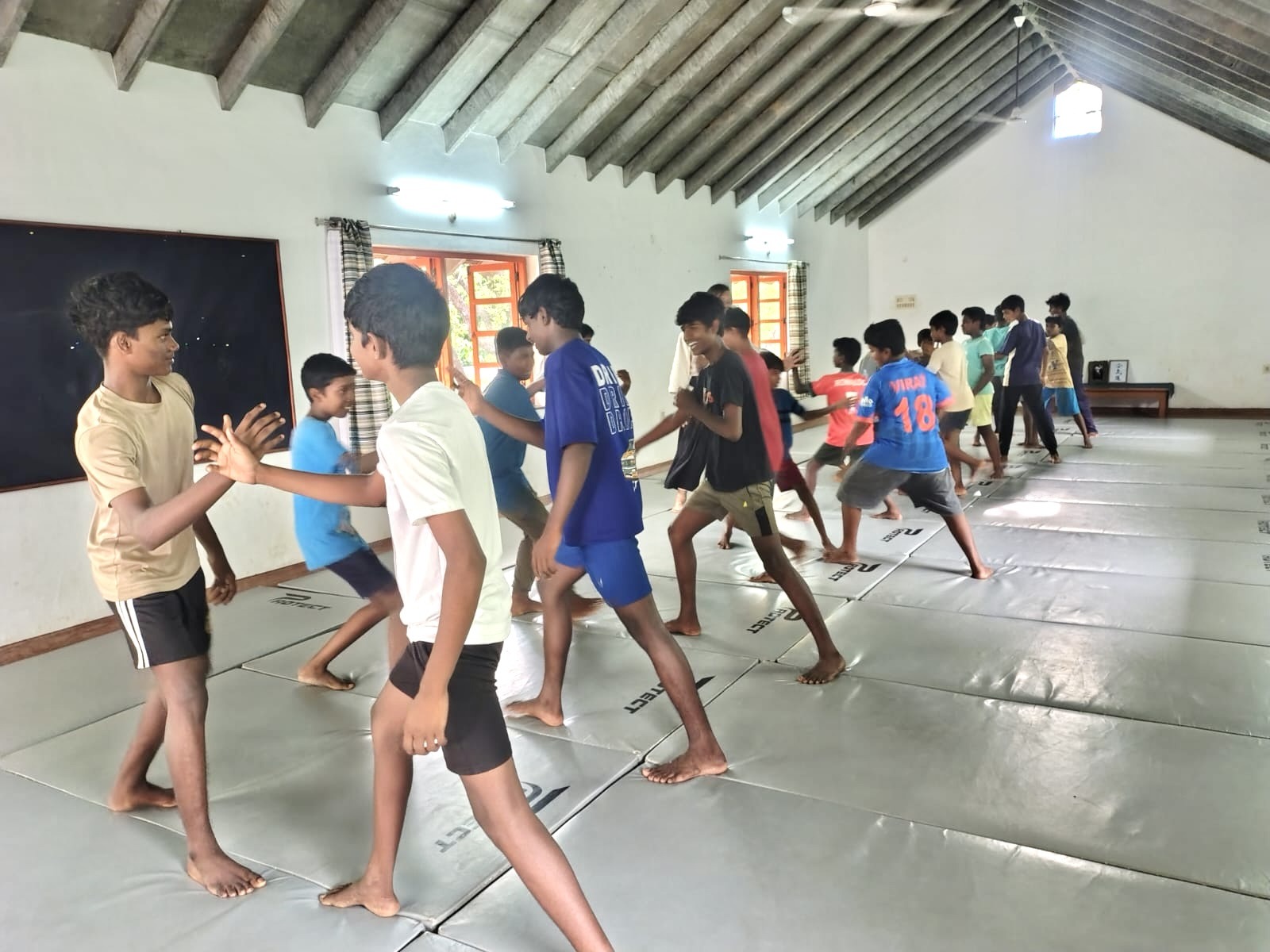
For Cristo, such examples point toward the dojo’s future: developing a younger generation capable of carrying the practice forward. That takes time. Aikido cannot be mastered in a year, and regular training over several years is needed even to reach the basic black-belt level, while deeper mastery continues throughout life.
Cristo embodies that commitment himself. Even after decades of practice, at 78, he continues to train, study, and teach, increasingly focused on transmission—passing as much knowledge as possible to the next generation. That transmission is already underway. A younger teacher, Michael Bondu has joined the teaching team and now practices and teaches daily, something Cristo had hoped for over many years. Another young teacher, Philippe Gourmel specializes in teaching kids from 7 to 16 years. And of course, Murugan who has practiced Aikido for 30 years and teaches adults’ classes every morning.
Learning without competing
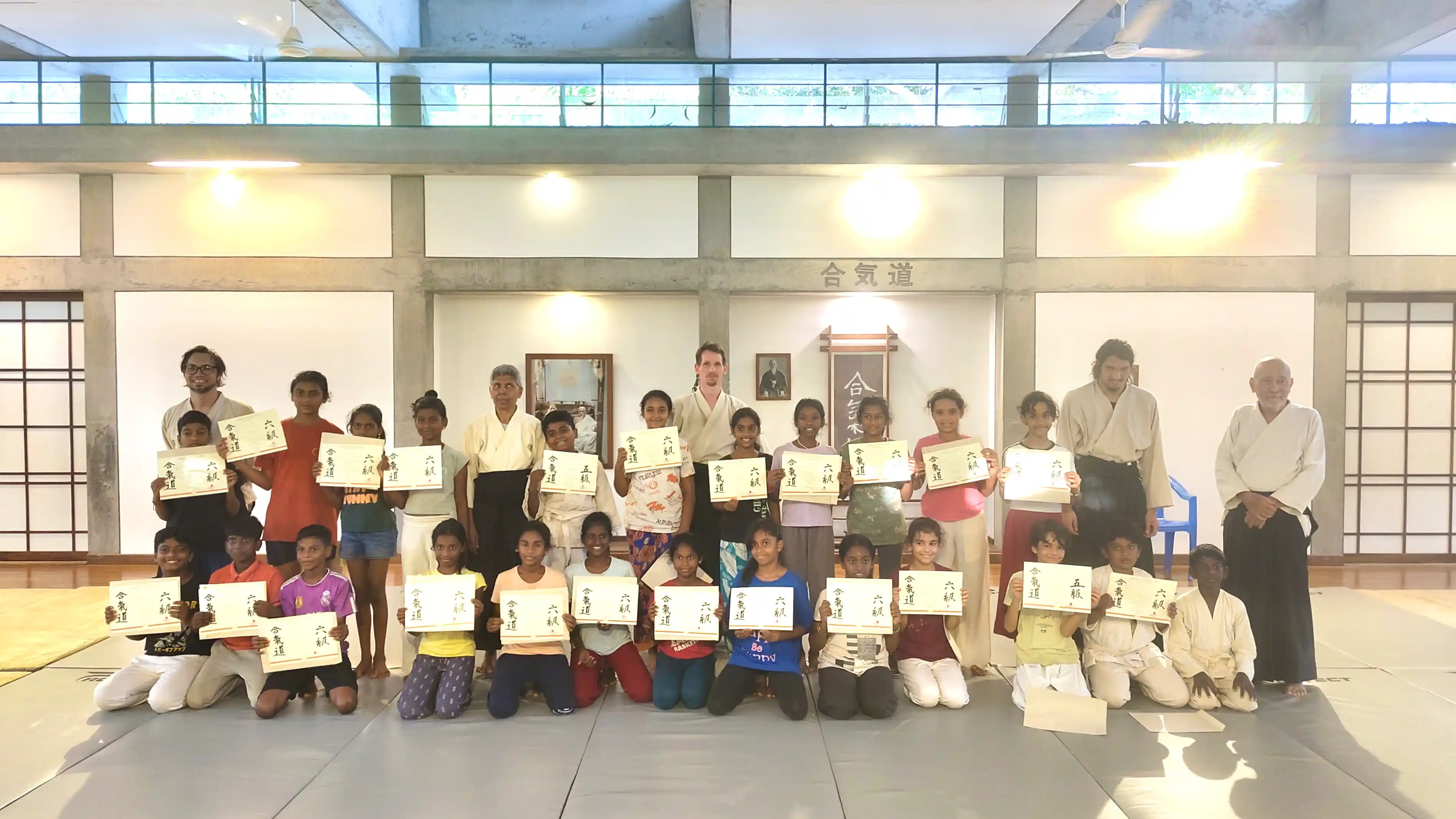
The dojo has its own way of recognizing progress while maintaining Aikido’s non-competitive character. Cristo does not favor the colored-belt system common in children’s martial arts programs; instead, students’ progress through the traditional Aikido system is rewarded with children receiving written certificates.
A student’s advancement is assessed by visiting senior teachers rather than the daily teacher alone, maintaining a connection between the Auroville dojo and the wider Aikido community. “Commitment is rewarded,” Cristo says.
The discipline of staying
Auroville can be a place of experimentation, with many practices to explore—but for those who find their way into Aikido, Cristo encourages them to stay. What begins as physical technique becomes an education in discipline, relationship, and awareness: learning to respond rather than react, work with others without aggression, and eventually pass the practice on as a teacher.
The story of Aikido in Auroville is one of continuity—from the teachers who brought the practice to the community, through years of training in temporary spaces, to today’s permanent home within a national and international network.
Underlying it all is Cristo’s conviction that the practice of the body, the cultivation of consciousness, and the sustained work of transformation are not separate pursuits. In that sense, the dojo is more than a place to learn a martial art. It is where a practice moves from one generation to the next, and where the discipline of continuity becomes itself a form of transformation.
Supporting the Budokan
Auroville’s Budokan Aikido Dojo can use your support to continue the incredible work that has unfolded in the past 50 years. It is currently supported by a small circle of committed donors.