
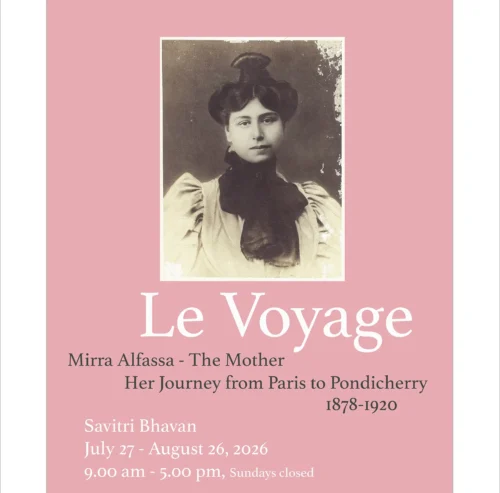
Le Voyage
The Mother’s Journey from Paris to Pondicherry, 1878-1920
Auroville’s Savitri Bhavan, July 27-August 26
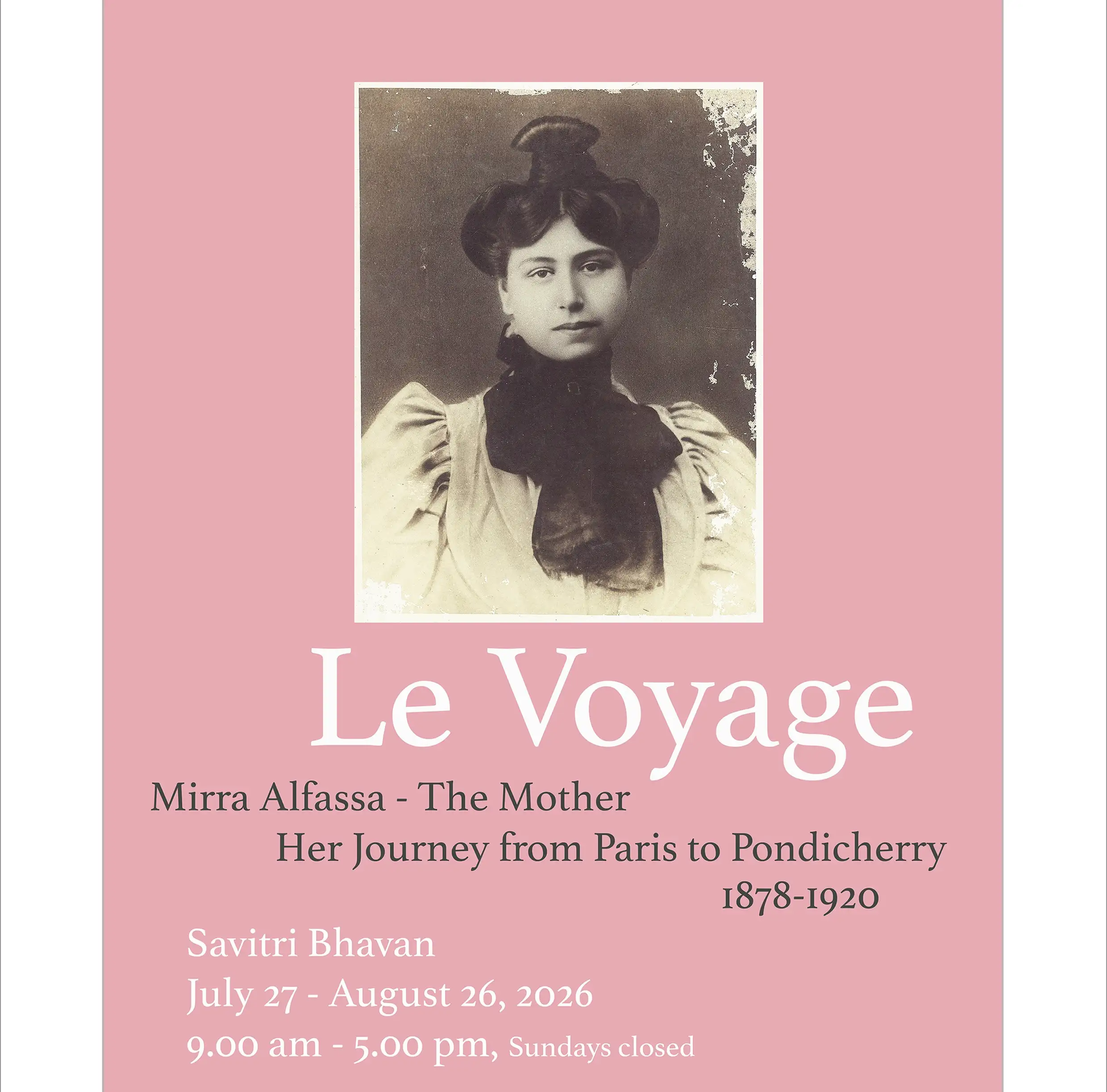
Savitri Bhavan’s new exhibition traces a real and metaphysical journey. Le Voyage invites visitors to walk alongside a young woman named Mirra Alfassa, decades before the world would come to know her as the Mother.
The exhibition is curated by Willemine Pernette. It was inaugurated by Dr. Alok Pandey on July 27 and will be open to visitors in the Exhibition Hall of Savitri Bhavan from July 27 to August 26, 2026.
This exhibition is presented by Savitri Bhavan, a centre in Auroville dedicated to the study and living appreciation of Sri Aurobindo’s epic Savitri, and of the lives, work, and vision of Sri Aurobindo and the Mother.
Since its founding, Savitri Bhavan has gathered materials, hosted programs, and built a space meant to hold the spirit of that work for visitors from around the world — offering its resources and educational programming freely, sustained entirely through donations. Auroville International USA has been proud to support Savitri Bhavan’s work over the years, helping sustain a place where the Mother’s own journey, and the deeper vision it opened onto, continues to be shared with new generations.
Le Voyage
Mirra Alfassa – The Mother
Her Journey from Paris to Pondicherry, 1878–1920
Mirra Alfassa, later known as the Mother, carefully preserved the story of her early life through her conversations, notebooks, paintings, photographs, letters, and even the simple postcards that accompanied her travels. Due to these records, her early journey remains well documented.
Born in Paris in 1878 into a cultured and prosperous family with roots in Egypt, Mirra Alfassa’s early life unfolded across cultures and continents. Le Voyage traces her early years by following the path of her journey—from Paris to Pondicherry, by way of Algeria and Japan. These years reveal her extraordinary openness to life through artistic creation, intellectual inquiry, inner discipline, encounters with different individuals and cultures, and an ever-deepening search for truth. Rather than turning away from the world, she embraced it as a field of conscious discovery.
Mirra spent four years in Japan (1916–1920). She later said that there she had to learn everything afresh. Artistically, she lived “from wonder to wonder.” Her years in Japan also deepened her understanding that her journey was not yet complete. After returning to India in 1920, she embraced a vision of unity that transcended national and cultural boundaries. Declaring herself “Indian by choice,” she sought to harmonise the wisdom of the East with the modernity of the West. Sri Aurobindo later recognised in her the embodiment of the Divine Mother.
Le Voyage brings together postcards and prints of the places where she lived, and of the people and landscapes that surrounded her. Original photographs signed by the Mother are displayed along the timeline between the cards. Together, these photographs, prints, and postcards have become the quiet witnesses of her journey.
Among the prints displayed are reproductions of the original postcards that travelled with Mirra across continents. These images can be seen in the last section of the exhibition. Sent by friends and family, they still bear their handwriting, postal stamps, addresses, and the marks of distant journeys. She preserved them throughout her life, carrying them from Europe and Japan to Pondicherry. Beyond their historical value, they reveal something deeply human: that alongside an immense spiritual destiny, there remained friendship, affection,beauty, and remembrance.
May this exhibition allow each visitor to look not only at the places the Mother once lived in, but also at the quiet unfolding of her consciousness through material life. As her early years gradually reveal themselves, they offer a deeper understanding of the path that prepared Mirra Alfassa to become the Divine Mother.
-Text by Willemine Pernette